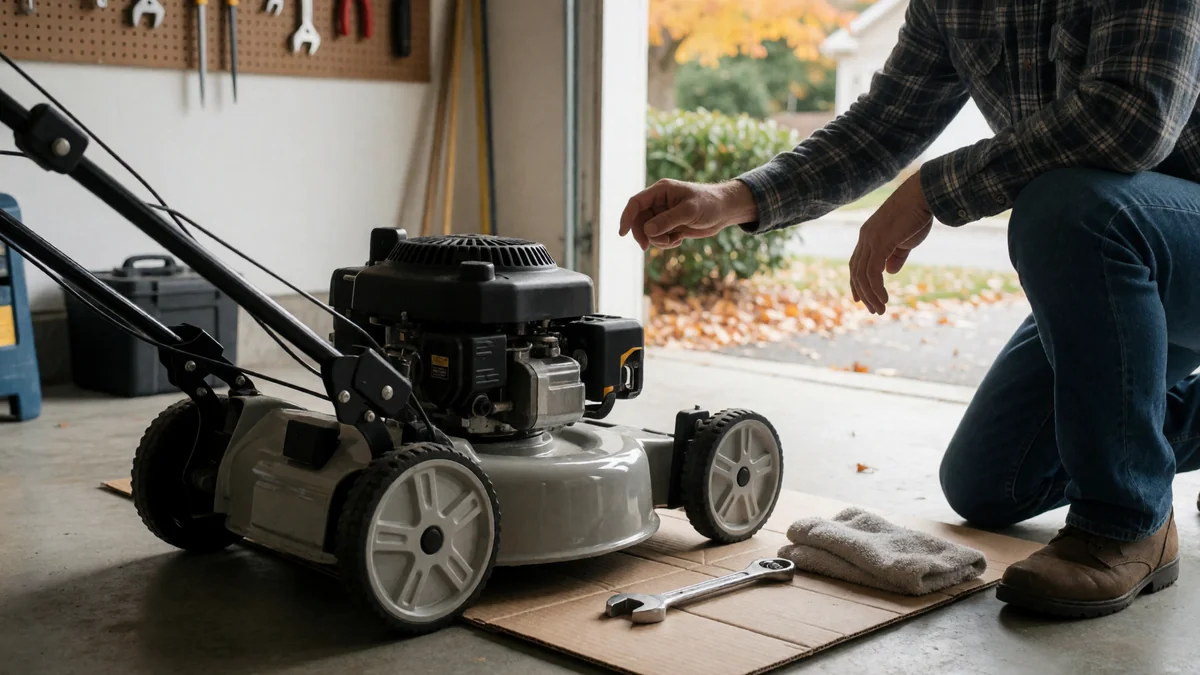
Most spring mower problems start in the fall. Old gas turns to varnish, dirty oil sits on engine parts all winter, and wet clippings rust out the deck. Taking an hour to winterize a lawn mower now means it fires up on the first or second pull next spring. Here’s exactly what to do for a typical walk-behind gas mower, plus a shorter checklist for battery mowers.
Quick answer: To winterize a lawn mower, add fuel stabilizer and run the engine (or run the tank dry), disconnect the spark plug, change the oil, clean the underside of the deck, sharpen or replace the blade, replace the air filter if it’s dirty, and store the mower in a dry place. Always follow your owner’s manual for oil type and capacity.
Get our best DIY tips, free
Practical home and yard projects, tool picks, and money-saving fixes in your inbox. No spam, unsubscribe anytime.
Safety first: Always disconnect the spark plug wire before touching the blade or tipping the mower. Work outdoors when handling gasoline, away from pilot lights and sparks, and let the engine cool before draining fuel or oil.
Stabilize or drain the gas?
Gasoline, especially ethanol-blended gas, starts to break down in about a month. Over a winter it can leave gummy deposits that clog the carburetor’s tiny passages, which is the most common reason mowers won’t start in spring. You have two good options:
- Stabilize: Add fuel stabilizer to fresh gas, fill the tank most of the way to limit condensation, and run the engine for five minutes so treated fuel reaches the carburetor. STA-BIL, for example, says its Storage formula keeps fuel fresh for up to 24 months.
- Run it dry: Run the mower until it stops, or siphon the tank and then run it until it dies. Check your manual; some manufacturers prefer one method over the other.
Tools you’ll need
Tools
- Socket wrench (the STANLEY 40-piece 1/4- and 3/8-inch socket set covers most mowers) and a spark plug socket
- Stiff putty knife or deck scraper
- Stiff scrub brush and garden hose
- 15-quart oil drain pan or oil siphon
- Mechanix Durahide leather work gloves and 3M Virtua CCS safety glasses
- Siphon pump (if draining fuel)
Materials
- Fuel stabilizer
- Small-engine oil (check your manual)
- Replacement spark plug (many Briggs & Stratton walk-behinds take a Champion RJ19LM) and an air filter for your model; match the part numbers in your manual
- Rags and a funnel
Recommended tool kit
Must-have: fuel stabilizer, the right small-engine oil, a socket set with a spark plug socket, a drain pan, a fresh spark plug, and gloves plus safety glasses. Check the current price on Amazon before you order.
Nice-to-have: a siphon pump if you store the mower dry, a 10-inch flat file and a blade balancer for sharpening, a spark plug gap tool, and a breathable mower cover for storage.
Time: about 1 hour · Skill: Beginner · Cost: low
How to winterize a lawn mower, step by step
Treat the fuel
Add stabilizer to the gas tank at the rate on the bottle, then run the mower for about five minutes to pull treated fuel into the carburetor. If you’d rather store it dry, siphon the tank into an approved gas can and run the engine until it stalls.
Pro tip: Treat your gas can too. Anything left in it will go stale over winter.
Disconnect the spark plug
Let the engine cool, then pull the boot off the spark plug and tuck it away from the plug. This keeps the engine from accidentally firing while you work near the blade.
Change the oil
Warm oil drains faster, so do this right after running the engine. Depending on your mower, remove the drain plug, tip the mower with the air filter side up, or use a siphon through the dipstick tube. Refill with the type and amount your manual specifies, usually SAE 30 or 10W-30 for walk-behind mowers.
Clean the deck
Tip the mower with the carburetor and air filter facing up so oil and gas don’t leak into them. Scrape caked clippings from the underside with a putty knife, then brush or hose it clean and let it dry.
Sharpen or replace the blade
Remove the blade, sharpen it with a file or grinder, and check balance by hanging it on a nail or using a blade balancer. Bent or cracked blades should be replaced. A sharp blade cuts cleanly and is healthier for your lawn.
Pro tip: Mark the bottom of the blade with paint before removing it so it goes back on the right way.
Replace the air filter
Paper air filters are cheap; replace them if they’re dirty. Foam filters can be washed in soapy water, dried, and lightly oiled per the manual.
Check or replace the spark plug
Remove the plug, check the gap (a coin-style gap tool makes this easy) and electrode, and replace it if it’s fouled or worn. Many people simply install a fresh plug every fall. Leave the boot disconnected until spring if you like.
Store it clean, dry, and covered
Park the mower in a garage or shed, off bare concrete if you can. Short on space? Our plan for how to organize a garage can clear a spot for it, or our guide on how to build a shed walks through building one step by step. A breathable cover keeps dust off. Don’t store gas-powered equipment near a furnace, water heater, or other open flame.
Supplies we’d buy for mower storage
Our pick
STA-BIL Storage Fuel Stabilizer, 32 oz
The classic orange bottle. The 32 oz size lasts most homeowners several seasons, and it also works in gas cans, string trimmers, snowblowers, and generators.
- STA-BIL says it keeps fuel fresh up to 24 months
- Dose is 1 oz per 2.5 gallons, per the label
- Works for all gas engines, 2- and 4-cycle
As an Amazon Associate we earn from qualifying purchases, at no extra cost to you.
For oil changes
Briggs and Stratton 100028 SAE 30 Engine Oil, 48 oz
A straight SAE 30 oil made for air-cooled walk-behind mower engines in warmer temperatures. Always match the viscosity your owner’s manual calls for.
- Made for 4-cycle small engines
- 48 oz bottle covers a typical mower oil change
- Widely recommended by small-engine makers
As an Amazon Associate we earn from qualifying purchases, at no extra cost to you.
If you drain the tank
GasTapper Deluxe Siphon Pump, 8 ft
A jiggle-style siphon: shake the weighted end in the tank and fuel starts flowing, no mouth siphoning required. Handy for mowers, snowblowers, and boats.
- Self-priming jiggler valve
- 8-foot anti-kink hose
- Shut-off clip to control flow
As an Amazon Associate we earn from qualifying purchases, at no extra cost to you.
A caked mower deck is easier to clean before the grass hardens in the garage all winter. If a scraper and a hose are not getting the underside clean, the VEVOR 2300 PSI electric pressure washer will cut through packed clippings quickly. Tip the mower only as the manual allows, pull the spark-plug wire first, and keep the spray off the engine, air filter, and any electrical parts.

For a dirty mower deck
VEVOR Electric Pressure Washer, 2300 PSI, 1.9 GPM, 1900W
The VEVOR 2300 PSI electric pressure washer is a 2300 PSI, 1.9 GPM electric washer with a 26-foot hose, four quick-connect nozzles, and a foam cannon. Use a wider fan tip on the deck, not a pinpoint jet that can drive water into bearings or under stickers. Check current price, and do this job in the yard, not in a closed garage.
- 2300 PSI electric, 1.9 GPM, 1900W
- 26-foot hose and four quick-connect nozzles
- Use a wide fan tip; keep water off the engine and air filter
’Round The House DIY may earn a commission if you buy through these links, at no extra cost to you.
Winterizing a battery-powered mower
Battery mowers are much simpler. Remove the battery, wipe the deck clean, and sharpen the blade. Store batteries indoors at room temperature, not in a freezing garage; most manufacturers recommend storing them partially charged. Check your manual for specifics.
When to take it to a shop
Take your mower to a small-engine shop if it smokes heavily, leaks oil, surges or stalls even with fresh fuel, or has a bent crankshaft from hitting a rock or stump. Fall and winter are the slow season for most shops, so you’ll get it back faster than in April.
While you’re putting yard gear away, it’s a good time to clear the last leaves. See our picks for the best cordless leaf blowers, and don’t forget to winterize your outdoor faucet before the first hard freeze.
Frequently asked questions
Either works. Stabilizer is easier and protects the carburetor if you run the engine after adding it. Running the tank dry avoids stale fuel entirely. Follow your mower manufacturer’s recommendation.
Yes. Used oil contains acids and contaminants that can sit on engine parts all winter. Changing it in the fall means you start spring with clean oil.
Only if it’s treated with fuel stabilizer and the engine has run long enough to pull treated fuel into the carburetor. Untreated gas can gum up the carburetor.
Tip it so the air filter and carburetor face up, usually spark plug side up. Check your manual, since tipping the wrong way can soak the air filter with oil.
No. Bring lithium-ion mower batteries indoors and store them somewhere cool and dry, above freezing, following the manufacturer’s guidance on charge level.
The bottom line
Fresh or stabilized fuel, clean oil, a clean deck, and a sharp blade: that’s all it takes to winterize a lawn mower. Spend an hour on it this weekend, and your first spring mow will start with a pull instead of a trip to the repair shop. Fall cleanup is also the right time to clean your gutters safely.

Leave a Reply