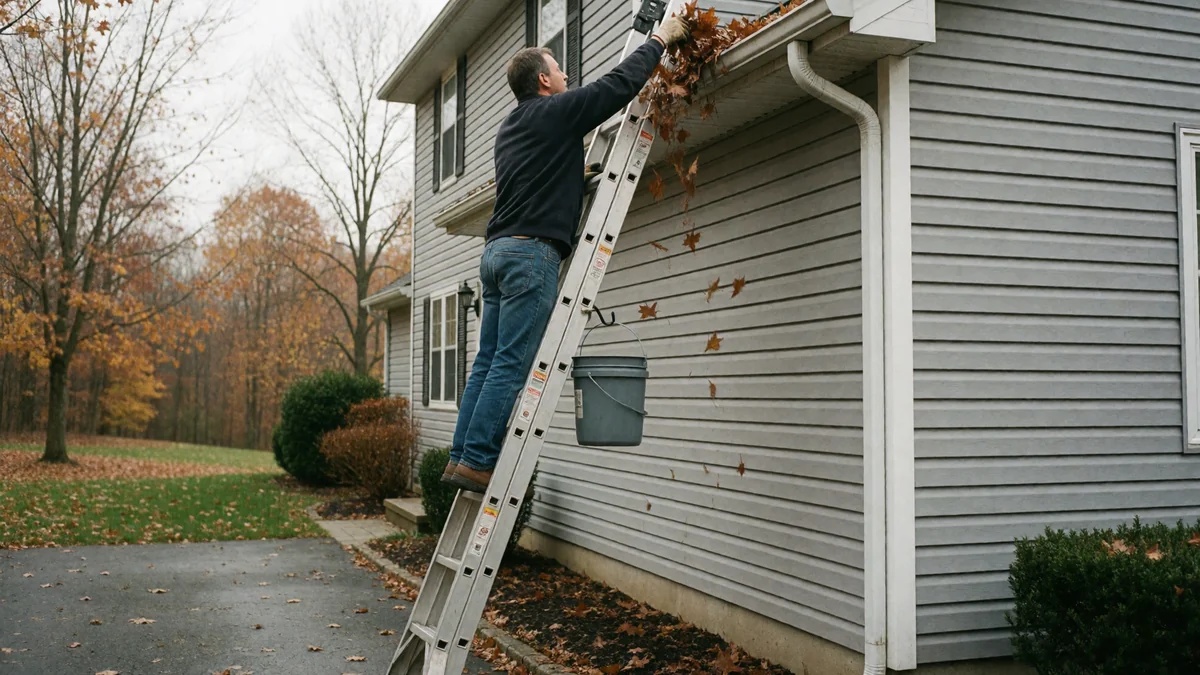
Once the last leaves come down, your gutters are probably packed with them. Learning how to clean gutters yourself saves money and heads off bigger problems: overflowing water that soaks the foundation, rotted fascia boards, and ice dams that push meltwater under your shingles. This guide covers a safe ladder setup, the fastest way to clear debris, and how to flush the downspouts so the whole system actually drains.
Quick answer: To clean gutters, set up a sturdy extension ladder on level ground at a safe angle, scoop debris into a bucket working away from the downspout, flush the gutter with a hose toward the downspout, then clear any clogged downspout from the bottom up. Clean them at least twice a year, and again after the leaves fall.
Get our best DIY tips, free
Practical home and yard projects, tool picks, and money-saving fixes in your inbox. No spam, unsubscribe anytime.
Safety first: Ladder falls send thousands of people to the ER every year; CDC’s NIOSH puts it at more than 500,000 people treated annually. If your gutters are more than one story up, your roof is steep, or there are power lines near the eaves, hire a gutter pro. Never work on a ladder alone.
When to clean your gutters
Most homes need gutter cleaning twice a year: once in late spring after trees drop seeds and blossoms, and once in late fall after the leaves are down. If you have pines or big oaks right over the roof, you may need a mid-season pass too.
Signs your gutters are overdue:
- Water spilling over the edge during rain instead of coming out the downspout
- Plants or seedlings sprouting in the gutter
- Sagging sections or gutters pulling away from the fascia
- Stains on the siding or eroded mulch right below the gutter line
Tools you’ll need
Tools
- Gutter scoop
- Extension ladder rated for your weight plus tools, such as a 24-foot fiberglass extension ladder (or rent one locally)
- Ladder stabilizer (standoff)
- Garden hose with a spray nozzle, like the Melnor XT metal 7-pattern nozzle
- Bucket with a wire handle and an S-hook or ladder bucket hook
- Mechanix Durahide leather work gloves and 3M Virtua CCS safety glasses
Materials
- Hefty Load & Carry contractor bags or a 10×12-foot heavy-duty tarp
- Geocel 2320 gutter and narrow seam sealant (if you find leaky seams)
Recommended tool kit
Must-have: a sturdy 24-foot fiberglass extension ladder, a ladder stabilizer so the ladder never rests on the gutter, a plastic gutter scoop, a hose nozzle, plus work gloves and safety glasses. Check the current price on Amazon before you order.
Nice-to-have: a ladder leveler for sloped ground, a 25-foot drain auger for packed downspouts, gutter seam sealant for drips, and an Orbit telescoping gutter wand if you would rather flush single-story gutters from the ground.
Time: 2–4 hours for most single-story homes · Skill: Beginner with ladder experience · Cost: low
Set up your ladder the safe way
Most gutter-cleaning injuries are ladder injuries, so this part matters more than anything else. OSHA’s extension ladder fact sheet lays out the basics, and they apply at home too:
- Use the 4-to-1 rule. For every 4 feet of height to where the ladder rests, set the feet 1 foot away from the wall.
- Firm, level footing. Avoid soft flower beds and slopes; use a ladder leveler if needed.
- Don’t lean the ladder on the gutter itself. A stabilizer (standoff) spans the gutter and rests on the roof or wall instead, so you don’t crush the gutter and you can reach into it.
- Keep three points of contact and your belt buckle between the rails. Move the ladder rather than overreaching.
- Check for power lines before you raise the ladder, especially near the service drop.
How to clean gutters, step by step
Start near a downspout
Set the ladder a few feet from a downspout. You’ll work away from it so you’re not pushing debris into the opening.
Scoop out the debris
Use a plastic gutter scoop to lift out leaves and muck. Drop it into a bucket hooked to the ladder, or onto a tarp below. Damp debris actually scoops easier than dry, dusty leaves.
Pro tip: Hang your bucket from a rung with an S-hook or ladder bucket hook so both hands stay free for the ladder and scoop.
Move the ladder, don’t stretch
Clear only what you can reach comfortably, then climb down and move the ladder. Leaning out sideways is how ladders tip.
Flush the gutter with a hose
Once the big stuff is out, run the hose (a pistol-grip nozzle with a jet setting helps) from the far end toward the downspout. Watch for standing puddles, which signal a sag that needs a hanger adjusted, and for drips at seams that need gutter sealant.
Clear the downspout
If water backs up, push the hose up the downspout from the bottom with the water on, or tap the side to loosen the clog. A plumber’s snake, such as a 25-foot drain auger, can help with stubborn packs of leaves. Make sure the downspout empties at least a few feet from the foundation.
Check the hangers and seams
While you’re up there, look for loose hangers, separated end caps, and leaking corners. Tightening a hanger screw now is far easier than fixing rotted fascia later.
Gear that makes gutter cleaning easier
These are inexpensive, well-reviewed pieces we’d add to the garage before the next cleanup.
Our pick
Amerimax 8300 Getter Gutter Scoop
A flexible plastic scoop shaped to fit standard gutters, with a raised handle that keeps your knuckles out of the gunk. It’s a small upgrade that makes the job noticeably faster than using your hands.
- Shaped to reach under gutter hangers
- Won’t scratch the gutter finish like a metal trowel
- Easy to rinse off
As an Amazon Associate we earn from qualifying purchases, at no extra cost to you.
Safety upgrade
Werner AC78 QuickClick Ladder Stabilizer
A standoff that clicks onto compatible Werner extension ladders, holding the top of the ladder away from the wall so it spans the gutter. Check Werner’s compatibility list before you buy, since it doesn’t fit every ladder.
- Keeps ladder weight off the gutter
- Wider stance at the top adds stability
- Tool-free attachment on compatible ladders
As an Amazon Associate we earn from qualifying purchases, at no extra cost to you.
A wet/dry vac is handy once the big scoops are out and you are left with wet leaves and sludge. The VEVOR 8-gallon wet/dry shop vac will pull that mess out of the trough without flicking it down the siding. It does not replace a stable ladder or a gutter scoop, and you still work from a properly set ladder, not from the roof.

Best for wet leaves and sludge
VEVOR 8-Gallon Wet/Dry Shop Vac (ZN2401CG-30L)
The VEVOR 8-gallon wet/dry shop vac is an 8-gallon metal-tank wet/dry vac with a 1.25-inch hose. That is a practical size for gutter sludge, and you can use it later for shop cleanup. Keep the hose short enough that you are not fighting it on the ladder, empty the tank before it gets heavy, and use the wet filter or foam sleeve for standing water.
- 8-gallon metal tank, wet and dry pickup
- 1.25 in. x 7 ft hose
- Useful later as a regular garage shop vac
’Round The House DIY may earn a commission if you buy through these links, at no extra cost to you.
Can you clean gutters from the ground?
Yes, for single-story homes. Telescoping gutter wands that attach to a hose, and gutter attachment kits for some leaf blowers, let you clear light debris without a ladder. They work best for dry leaves and routine maintenance, not packed, wet sludge. If you already own a cordless blower, check whether the brand sells a gutter kit; our guide to the best cordless leaf blowers covers a few popular models.
When to hire a pro
Hire a gutter service if your gutters are two or more stories up, your roof is steep or slick, you aren’t comfortable on a ladder, or the gutters are sagging and need re-hanging. Many pros will also inspect the roof edge while they’re up there.
Doing a whole fall checklist? Pair this with our guides to winterizing your outdoor faucet and hanging Christmas lights on your roofline, since you’ll already have the ladder out.
If a clogged gutter has already sent water toward the foundation, the basement may still feel damp after you clean. A dehumidifier will not fix the overflow, but it can dry the space while you keep the gutters clear (affiliate link).
If the basement is already damp
Frigidaire 50 Pint Energy Star Dehumidifier
This Frigidaire model removes up to 50 pints of moisture per day in areas up to 1,200 square feet, including finished basements. It is Energy Star rated, runs in cool basements down to 41°F with automatic defrost, and is available with an optional built-in pump so you do not have to empty the bucket by hand.
- Removes up to 50 pints of moisture per day in spaces up to 1,200 square feet
- Energy Star rated, and it can run down to 41°F with automatic defrost
- Optional built-in pump, plus a washable filter and casters
Affiliate link: I may earn a commission at no extra cost to you.
Frequently asked questions
At least twice a year, in late spring and late fall. Homes with lots of overhanging trees may need cleaning three or four times a year.
It can be on a single-story home with a sturdy ladder, a helper, and level ground. For two-story homes, steep roofs, or nearby power lines, hiring a professional is the safer choice.
Scoop out the heavy debris with a plastic gutter scoop, then flush the gutter and downspout with a hose. For light, dry leaves, a blower with a gutter attachment or a hose wand can work from the ground.
No. Guards reduce how often you clean, but fine debris, pine needles, and shingle grit still build up, and the guards themselves need occasional clearing.
Water overflows near the foundation, which can lead to wet basements, rotted fascia boards, and ice dams in winter. Heavy, waterlogged debris can also pull gutters loose.
The bottom line
Cleaning your gutters is mostly about doing it safely and doing it on schedule. Get the ladder set up right, use a scoop and a hose, and make sure the downspouts run clear. A couple of afternoons a year keeps water where it belongs: away from your house. While you are getting the house ready for winter, it is also a good time to winterize your lawn mower and weatherstrip your doors.

Leave a Reply