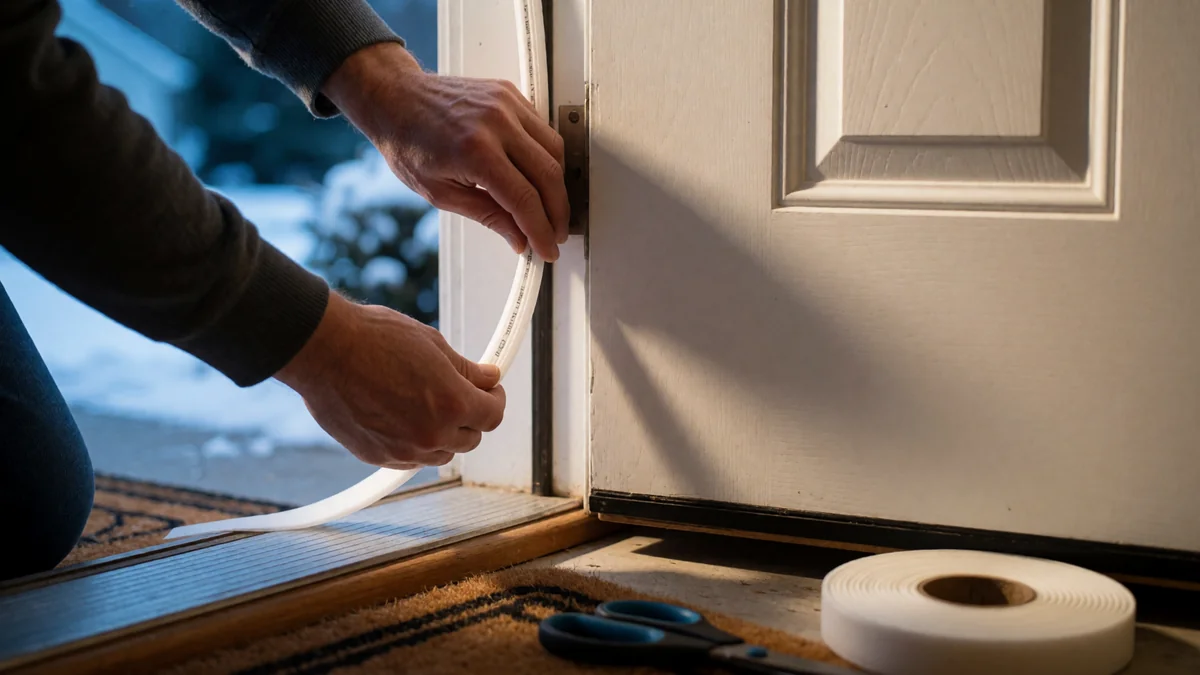
If you can feel a chill near your front door, or see daylight around the edges, that door is leaking heated air all winter. Learning to weatherstrip a door is one of the cheapest, fastest ways to make a room more comfortable. The U.S. Department of Energy calls caulking and weatherstripping simple and effective air-sealing techniques you can do yourself. This guide shows you how to find the leaks, choose the right seal, and install it.
Quick answer: To weatherstrip a door, find where air leaks (daylight, drafts, or a dollar-bill test), replace worn foam or rubber seals along the jamb, add or replace the door sweep at the bottom, and adjust the threshold if it’s adjustable. Most exterior doors can be weatherstripped in one to two hours.
Get our best DIY tips, free
Practical home and yard projects, tool picks, and money-saving fixes in your inbox. No spam, unsubscribe anytime.
Find the drafts first
Before buying anything, figure out where the air is getting in:
- Daylight test: On a sunny day, close the door and look for light around the edges. Any light means a gap.
- Dollar-bill test: Close the door on a dollar bill in several spots. If it slides out easily, the seal isn’t touching.
- Hand or incense test: On a cold, windy day, move your hand or a lit incense stick slowly around the frame and watch for drafts.
- Look at the old seal: Flattened, torn, cracked, or missing weatherstripping needs replacing.
Types of door weatherstripping
Kerf-mounted seals
Most modern pre-hung exterior doors have a thin slot, called a kerf, cut into the door stop. The weatherstrip has a barbed fin that presses into that slot. If you pull out your old seal and see a groove, this is what you need.
Adhesive foam tape
For older doors without a kerf, self-adhesive foam tape is the easy option. It’s inexpensive but usually needs replacing every season or two.
V-strip (tension seal)
A folded vinyl or metal strip that springs open to fill the gap. It’s durable and nearly invisible, and works well on the sides of a door.
Door sweeps and threshold seals
The bottom of the door is often the worst leak. A door sweep screws to the inside face of the door, and many thresholds have a replaceable rubber insert or adjustment screws. A cordless drill/driver makes quick work of the sweep screws.
Tools you’ll need
Tools
- Tape measure, like the STANLEY FatMax 25-foot tape
- STANLEY Classic 99 utility knife or sharp Fiskars 8-inch scissors
- STANLEY 12-inch hacksaw (for cutting metal door sweeps)
- Drill/driver, such as the DEWALT 20V MAX drill/driver kit (DCD777D1)
- Plastic putty knife set and a rag
Materials
- Kerf-mount replacement door seal
- Screw-on door sweep
- Rubbing alcohol (to clean surfaces)
Recommended tool kit
Must-have: a tape measure, a utility knife, a plastic putty knife, a drill/driver, and the seals themselves: a kerf-mount door seal or adhesive foam weatherstrip for the jambs and a screw-on door sweep for the bottom. Check the current price on Amazon before you order.
Nice-to-have: a hacksaw if your sweep needs trimming and sharp scissors for clean cuts on foam and vinyl.
Time: 1–2 hours · Skill: Beginner · Cost: low
How to weatherstrip a door, step by step
Remove the old weatherstripping
Pull kerf-style seals straight out of the slot. Scrape off old foam tape and adhesive with a plastic putty knife. Clean the surface with rubbing alcohol and let it dry.
Measure and cut the new seal
Measure the head (top) and both side jambs with a tape measure. Cut the new weatherstrip to length with a utility knife or scissors; most kits are cut longer than you need. Mitered corners at the top look neater, but square cuts that butt tightly work fine.
Install the jamb seals
For kerf seals, start at the top corner and press the fin into the slot with your thumb, working down. A plastic putty knife helps seat it. For foam tape, peel the backing a few inches at a time and press it onto the door stop where the door closes against it.
Pro tip: Close the door and check it latches easily. Too-thick foam can make the door hard to close.
Install the door sweep
Close the door and hold the sweep against the inside bottom so its seal lightly touches the threshold. Mark the screw holes, drill pilot holes with a drill/driver, and fasten it. Many sweeps have slotted holes so you can fine-tune the height. If a metal sweep is longer than your door, trim it first with a hacksaw. The Department of Energy’s Building America Solution Center has a step-by-step door sweep guide with photos.
Adjust the threshold
Many thresholds have screws under caps that raise or lower the center section. Raise it until the door bottom seals without dragging.
Test it
Repeat the dollar-bill and daylight tests. Adjust the sweep or threshold until the door closes smoothly and seals all around.
Weatherstripping we’d buy

Best for most modern doors
M-D Building Products Vinyl-Coated Foam Kerf-Mount Door Seal #91868, 81 inch
A vinyl-clad foam seal with a fin that presses into the kerf slot on most pre-hung exterior doors. It replaces worn factory seals along the top and sides.
- Presses in by hand, no tools needed
- 81-inch length covers a standard door side
- Vinyl skin over foam stays flexible
As an Amazon Associate we earn from qualifying purchases, at no extra cost to you.

Best door sweep
M-D Building Products Commercial Screw-On Door Sweep #68247, 36 inch
A 36-inch screw-on sweep with a thermoplastic rubber seal in a silver aluminum housing. It seals the gap between the door bottom and the threshold, which is often the biggest single draft. M-D rates this commercial sweep to seal gaps up to 3/8 inch.
- 36-inch length can be cut to fit narrower doors
- Thermoplastic rubber seal in a silver aluminum housing
- Seals gaps up to 3/8 inch; screws included
As an Amazon Associate we earn from qualifying purchases, at no extra cost to you.

Alternative sweep
M-D Building Products Heavy-Duty Screw-On Door Sweep #05389, 36 inch
A screw-on sweep with a double-fin vinyl seal in a heavy-duty aluminum retainer. M-D rates it to seal gaps up to 3/4 inch, so it is a better fit than the rubber commercial sweep when the space under the door is a little larger than 3/8 inch.
- Heavy-duty aluminum retainer with a double-fin vinyl seal
- Cuts to length with a hacksaw
- Seals gaps up to 3/4 inch; screws included
As an Amazon Associate we earn from qualifying purchases, at no extra cost to you.
When the problem isn’t the weatherstripping
If the door still leaks after new seals, the problem may be the door itself. Check for loose hinges (tighten the screws or use longer ones that bite into the framing), a warped door slab, or a frame that’s out of square. Rotted sills, big gaps around the frame, or a door that won’t latch are good reasons to call a carpenter or door installer. South Carolina’s state energy office has a helpful weatherstripping overview if you want to tackle windows next.
Weatherstripping is a great companion to other cold-weather jobs. Pair it with our guides to installing a smart thermostat and winterizing an outdoor faucet for a warmer, more efficient winter.
Frequently asked questions
Look for daylight around the closed door, feel for drafts on a windy day, or close the door on a dollar bill. If the bill slides out easily or the seal is flattened, cracked, or missing, replace it.
For most modern pre-hung doors, a kerf-mounted foam or rubber seal works best because it locks into the slot in the door stop. Older doors without a kerf can use V-strip or adhesive foam tape.
Adhesive foam tape may last a season or two. Quality kerf-mounted seals and metal or vinyl V-strips often last several years before they flatten or crack.
Yes, lightly. The seal should brush the threshold to block air without making the door hard to open or close.
Yes, if the seal is too thick. Choose a thinner profile or adjust the strike plate slightly if the door won’t latch after weatherstripping.
The bottom line
A drafty door is one of the easiest comfort fixes in the house. Find the leaks, replace the jamb seals, add a door sweep, and adjust the threshold. In an afternoon, you can weatherstrip a door and feel the difference the same night. A sealed door also helps the house hold heat longer if the power goes out; see our guide to portable power stations for home backup.

Leave a Reply