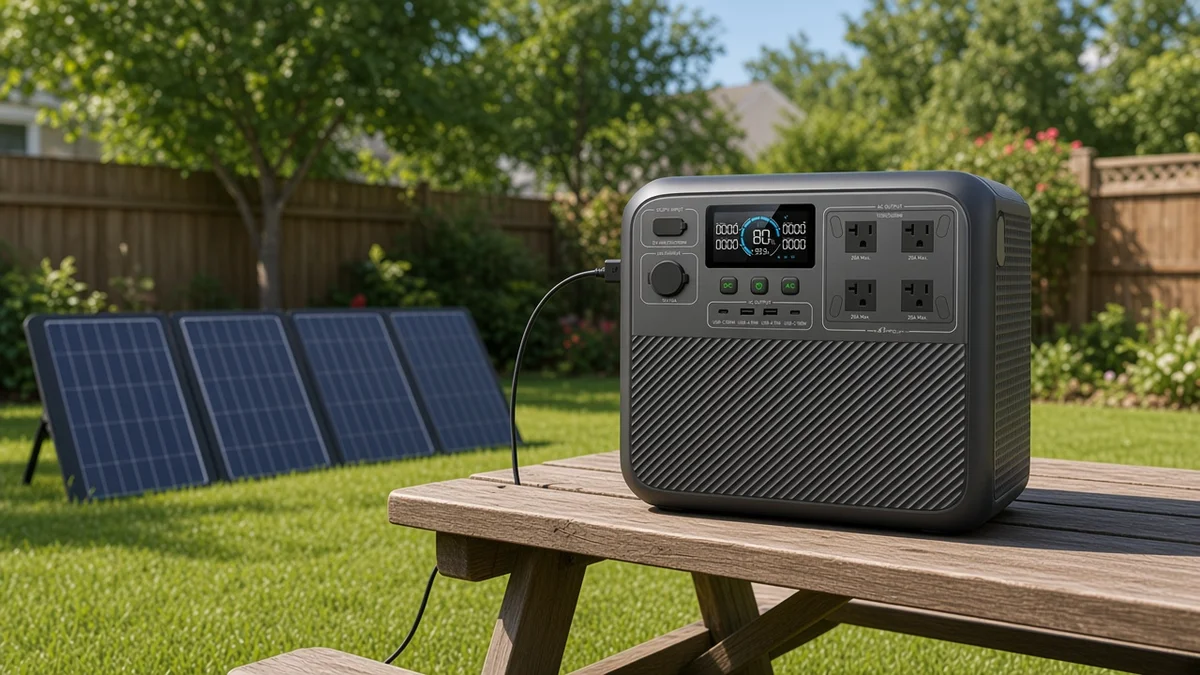
A winter power outage is harder on a house than a summer one. The food in the fridge still matters, but so does the furnace blower, a sump pump if the weather turns to rain or a thaw, a CPAP machine, and a way to keep phones and a few lights on. A portable power station is a rechargeable battery with a built-in inverter, so it can run ordinary household plugs without gasoline and without exhaust. That makes it a practical indoor backup for selected essentials, as long as you size it honestly and don’t try to heat the house with it. We compared current BLUETTI models and official specs to find the best portable power stations for home backup in a winter outage.
Quick answer: Add up the running watts of everything you want on at once, then make sure the station’s output can also cover the biggest motor startup surge, usually the refrigerator or a sump pump. Capacity, in watt-hours, is what determines how long it lasts. A compact station around 1 kWh, such as the BLUETTI Elite 100 V2, is a strong fit for phones, lights, a router, and a CPAP. For a refrigerator plus those essentials, a midsize unit around 2 kWh with roughly 2,000 watts or more of output, such as the Elite 200 V2, is the more comfortable starting point. If you want to expand later or need 120- and 240-volt output, look at the Apex 300. Don’t plan on running a space heater from any of these; at 1,500 watts it will empty even a large station in a hurry. And never bring a gasoline generator indoors.
Get our best DIY tips, free
Practical home and yard projects, tool picks, and money-saving fixes in your inbox. No spam, unsubscribe anytime.
Our picks at a glance
- Best compact backup: BLUETTI Elite 100 V2
- Best midsize backup for most homes: BLUETTI Elite 200 V2
- Best expandable backup: BLUETTI Apex 300
How to size a portable power station for a winter outage
Two numbers matter, and they are not interchangeable. Output, in watts (W), is whether the station can start and run a device. Capacity, in watt-hours (Wh), is how long it can keep that load going. A station can have plenty of stored energy and still shut down if a motor’s startup surge is higher than its output, or it can start everything and run dry in an hour if the battery is too small.
The honest way to size one is to read the nameplate on each appliance, or better, to measure it with a plug-in watt meter before you need it. On most 120-volt devices, watts are roughly amps times 120. Add the running watts of everything that will be on together, then add the largest single startup surge on top of the rest. Motors and compressors often pull two or three times their running wattage for a second or two when they start.
Runtime is roughly usable capacity divided by the watts you’re actually drawing. You won’t get every advertised watt-hour out of the battery; inverter losses and leaving a reserve take a slice, so a conservative plan is to treat about 80% of the listed Wh as usable. A 2,000Wh station, on that math, is about 1,600 watt-hours, or eight hours at a steady 200-watt load.
Refrigerator
A refrigerator is the appliance most people want to save first, and it’s an awkward mix of a modest average draw and a sharp startup kick. Typical running wattage spans a wide range, often from about 100 to 800 watts depending on size and age, and because the compressor cycles on and off, the average over a day is commonly more like 150–250 watts. The surge when the compressor starts is what trips a too-small inverter. A 1,000-watt station can be tight; an 1,800-watt class inverter has a better chance with a modern fridge. If a fridge averages 200 watts, that’s 0.2 kWh for every hour of compressor time, or very roughly a kilowatt-hour over a day of typical cycling, more if the door is opened often. A compact 1 kWh station may cover part of a day; a midsize 2 kWh station is a more comfortable overnight-to-one-day buffer. The CDC notes that a closed refrigerator keeps food safe for about four hours without power, so even a few hours of backup is useful.
Furnace blower
On a gas furnace, the part that needs electricity is the blower (and the control board), not the burners. That motor often draws a few hundred watts once it’s running, with a higher surge at startup. Many midsize stations can handle that if you aren’t also starting a fridge or a pump at the same instant. What these units will not do is run an electric furnace or the backup heat strips on many heat pumps, which can pull many thousands of watts. If your heat is electric, plan on a smaller safe space, extra blankets, and a station reserved for lights, communications, and medical devices, not whole-house heat.
Sump pump
A 1/2-horsepower sump pump commonly draws around 800–1,000 watts while running, and the startup surge can be roughly double that. That’s a midsize or larger output job, not a compact one. The pump usually runs in short bursts, so it may not drain a 2 kWh battery as fast as a continuous load of the same wattage. Confirm the numbers on the nameplate, and don’t share the station with another heavy surge load at the same moment the pit is filling.
CPAP, phones, and lights
A CPAP is a relatively small, steady load compared with a fridge or a pump. Many units draw well under 100 watts, especially without a heated humidifier; the heated tube or humidifier is what pushes the number up. Check the label on your machine. A compact or midsize station can typically run one overnight with room to spare, and a fast UPS switchover, 10 milliseconds or less on the Elite 100 V2, is worth having so the machine doesn’t drop during the outage. Phones, LED lights, and a Wi-Fi router are even lighter. A few LED bulbs and a phone charger might total 20–40 watts, which a 1 kWh station can carry for a long time.
Why you shouldn’t run a space heater on a power station
A typical portable electric heater is 1,500 watts. At full power that’s 1.5 kilowatt-hours every hour. The Elite 100 V2‘s 1,024Wh battery would be done in well under an hour; the Elite 200 V2, at about 2 kWh, is roughly an hour; the Apex 300‘s 2.7 kWh base battery is still well under two hours, and that’s before you leave anything for the fridge. Some BLUETTI models have a Power Lifting mode that can electrically support a high-wattage resistive load, so the question isn’t always whether the inverter will allow it. It’s whether you want to spend the entire battery on a single room of heat.
Use the station for the loads that actually need electricity, and hold heat in the house instead. Close off unused rooms, add a layer, and fix the drafts you already know about, such as weatherstripping a drafty door and insulating windows for winter. If a heater is part of your plan, plug it into a working wall outlet, not into the battery, and follow the safety advice in our guide to the best space heaters. Keeping the house from getting too cold also helps prevent frozen pipes and can reduce the roof-melting that leads to ice dams.
Safety: indoor batteries vs. gas generators
A battery power station produces no carbon monoxide, which is the main reason it’s a better indoor backup than a gasoline generator. Use it dry and upright, indoors or on a covered porch, and stay inside the manufacturer’s charging and discharging temperatures. BLUETTI’s current Elite and AC-series manuals commonly allow discharging down to −4°F and charging only at 32°F and above, so in a cold garage you can run the station, but you should bring it inside to recharge. The units are not waterproof.
A portable gasoline generator is a different tool, and the exhaust is dangerous. The U.S. Consumer Product Safety Commission says never to operate a generator inside a home, garage, basement, or shed, or near a window or vent. The CDC is more specific: keep it outdoors at least 20 feet from any window, door, or vent, and use a battery-powered or battery-backup CO alarm (affiliate link). Carbon monoxide is odorless and can kill quickly. The same goes for charcoal grills and camping stoves; they are not indoor heaters.

Don’t backfeed a power station or a generator into a dryer outlet or another receptacle in the house. That can energize lines a utility worker thinks are dead. Plug appliances directly into the station, or have a licensed electrician install a listed transfer switch or interlock if you want to power selected circuits from a larger system. While you’re preparing the house, it’s also a good time to winterize outdoor faucets so a freeze isn’t the next problem you have to solve in the dark.
The best compact portable power station

Best compact backup
BLUETTI Elite 100 V2
A 1,024Wh LiFePO₄ station with 1,800 watts of continuous output and a Power Lifting mode rated at 2,700 watts, in a package BLUETTI lists at about 25 pounds. It charges to 80% in 45 minutes on a 1,200-watt AC turbo input, accepts up to 1,000 watts of solar, and switches over as a UPS in 10 milliseconds or less. It’s about $499 at BLUETTI (check current price), and it’s the compact pickup we’d look at first for phones, lights, and a night of medical or communications gear. The 1,800-watt inverter has enough headroom to start many modern fridges, though the 1 kWh battery won’t carry a fridge as far as a midsize unit.
- 1,024Wh capacity and 1,800W output in about 25 pounds, per BLUETTI
- LiFePO₄ cells rated for 4,000+ cycles to 80% capacity; 5-year warranty
- Up to 1,000W solar input and a 10ms UPS switchover
Affiliate links: I may earn a commission at no extra cost to you. As an Amazon Associate we earn from qualifying purchases.
The best portable power station for most home backups

Best for most homes
BLUETTI Elite 200 V2
This is the midsize station we’d buy first for a typical winter outage kit. BLUETTI rates it at 2,073.6Wh (listed as 2,080Wh on some pages) with 2,600 watts of continuous output and a 3,900-watt Power Lifting mode for resistive loads. Official comparison notes list 1,000 watts of solar input and an 1,800-watt AC input; the unit is said to reach 80% in about 1.1 hours on wall power. It uses LiFePO₄ cells rated for 6,000+ cycles, weighs about 53 pounds, and is about $899 at BLUETTI (check current price). That mix of output and capacity is what you want if the fridge, a furnace blower, and a few household essentials all have to share one battery.
- About 2 kWh of LiFePO₄ capacity with 2,600W continuous output
- 6,000+ cycles to 80% and a 5-year warranty, per BLUETTI
- 1,000W solar input and fast AC charging, in a single carry-in unit
Affiliate links: I may earn a commission at no extra cost to you. As an Amazon Associate we earn from qualifying purchases.
The best expandable power station for longer outages

Best expandable backup
BLUETTI Apex 300
The Apex 300 is the step up when you want more than a single carry-in battery. The base unit is 2,764.8Wh with 3,840 watts of continuous output and 7,680 watts of lifting power, and it can supply 120-volt and 240-volt loads at the same time. BLUETTI lists the weight at about 83.8 pounds, two native solar inputs totaling 2,400 watts, LiFePO₄ cells with 6,000+ cycles to 80%, and a 5-year warranty. It expands with compatible BLUETTI batteries (B300K and B500K kits are sold alongside it). A panel hookup belongs with a licensed electrician and the right accessories. The base unit is about $1,499 at BLUETTI (check current price); the regular listed price is $1,699.
- 2,764.8Wh and 3,840W in a 120V/240V base unit, about 84 pounds
- Expandable with compatible BLUETTI batteries for longer outages
- Up to 2,400W native solar input; 6,000+ cycle LiFePO₄; 5-year warranty
Affiliate links: I may earn a commission at no extra cost to you. As an Amazon Associate we earn from qualifying purchases.
BLUETTI still sells earlier models if you want a lower starting price or a different mix of features. The AC70 is a 768Wh, 1,000-watt station, about $359 at BLUETTI (check current price) and about 22.5 pounds, with 500 watts of solar input. It’s a reasonable budget pick for phones, lights, and a CPAP, but the 1,000-watt output (1,500-watt surge, or 2,000 watts in Power Lifting mode for resistive loads only) is tight for a fridge compressor. The AC180 is a 1,152Wh, 1,800-watt unit, about $549 at BLUETTI (check current price), that overlaps the Elite 100 V2 in role but is heavier, about 37 pounds, and takes a lower 500-watt solar input. The AC200L is a 2,048Wh, 2,400-watt station that BLUETTI says can expand from 2 kWh up to 7,577.6Wh with extra batteries and accept up to 1,200 watts of solar. If expandability at the 2 kWh size matters more than the Elite 200 V2‘s higher 2,600-watt output, it’s the one to compare. Prices and shipping dates change; some current models were listed on pre-order when we checked in mid-November 2026.
Solar charging in a winter outage
A station you can top up during the day is more useful in a multi-day outage than one you can charge only from the wall. The Elite 100 V2 and Elite 200 V2 both accept up to 1,000 watts of solar; the Apex 300 accepts up to 2,400 watts on its two native inputs. Real-world winter input is usually much lower. Days are short, the sun sits low, snow on the panels blocks light, and the station will only accept panels that match its voltage window and connector, often MC4. Treat solar as a helpful trickle, not as a guarantee you’ll be full again by sunset.
Deals for this project
Browse BLUETTI’s portable power stations, kits, and compatible solar panels in one place. If you also keep a generator for longer outages, a working carbon monoxide alarm belongs in the house; start with X-Sense carbon monoxide alarms.
‘Round The House DIY may earn a commission if you buy through these links, at no extra cost to you.
Frequently asked questions
You need enough output to cover the compressor’s startup surge, often two or three times the running wattage, and enough capacity for the hours you care about. A 1,000-watt station can be tight; an 1,800-watt class unit has a better chance of starting a modern fridge, and a midsize 2 kWh station is a more comfortable day-long buffer. Check the nameplate or measure with a plug-in watt meter.
It can often run the blower on a gas furnace, which typically draws a few hundred watts once it’s running, if the station also covers the startup surge. It will not run an electric furnace or the backup heat strips on many heat pumps.
Usually no. A typical 1,500-watt heater uses 1.5 kilowatt-hours every hour at full power, so even a 2 kWh station is about an hour of heat. That leaves little energy for the fridge or a medical device.
A battery power station produces no exhaust, so it can be used indoors in a dry, upright spot, within the manufacturer’s temperature limits. Never run a gasoline generator inside a home, garage, basement, or shed. The CDC says keep it outdoors at least 20 feet from windows, doors, and vents, and use a working carbon monoxide alarm.
Runtime is roughly usable capacity divided by the watts you’re drawing. Plan on a bit less than the advertised watt-hours after inverter losses and a reserve. Lights and phones last a long time on a compact station; a cycling fridge uses far less than its nameplate suggests over a full day. Winter solar can help, but don’t count on a full-speed recharge.
Only with a listed transfer switch or interlock, usually installed by a licensed electrician. Never backfeed a station into a dryer outlet or other receptacle. For a straightforward setup, plug appliances directly into the station.
The bottom line
The best portable power station for home backup is the one that can start your heaviest essential motor and still have enough watt-hours left for the rest of the night. For a light kit of phones, lights, and a CPAP, we’d buy the Elite 100 V2. For a fridge plus a furnace blower and those essentials, we’d buy the Elite 200 V2. If you want 240-volt output or a system you can grow with extra batteries, the Apex 300 is the one to start with. Charge it indoors before the storm, keep gas generators far from the house, and spend the battery on food, heat-circulation, water, and medical devices, not on a space heater. A tighter house, from insulated windows to a winterized faucet, makes that stored energy last longer.

Leave a Reply