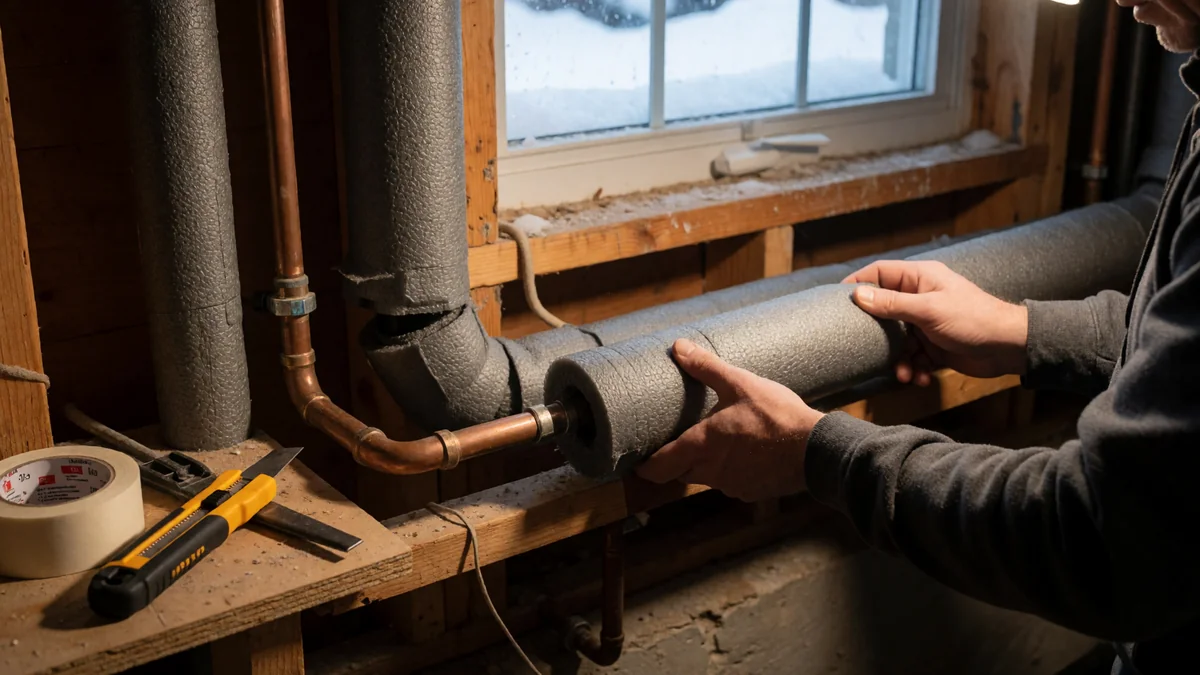
A hard freeze doesn’t have to end with a flooded kitchen. Most burst-pipe damage is preventable if you protect the vulnerable lines before overnight temperatures drop and stay below freezing. This guide covers how to prevent frozen pipes in a typical house, what to do during a cold snap, and how to thaw a pipe safely if one freezes anyway.
Quick answer: To prevent frozen pipes, disconnect hoses and winterize outdoor faucets, insulate exposed pipes in garages, crawl spaces, attics, and under exterior-wall sinks, and seal the drafts that blow on those lines. During a deep freeze, keep the heat on (at least 55°F if you’re away), open cabinet doors, and let a faucet trickle on the coldest walls. If a pipe freezes, open the faucet and warm the pipe with a heating pad or hair dryer, never an open flame.
Get our best DIY tips, free
Practical home and yard projects, tool picks, and money-saving fixes in your inbox. No spam, unsubscribe anytime.
Why pipes freeze (and which ones go first)
Water expands as it turns to ice. In a closed pipe, that pressure can split copper, PEX, or PVC, often at a fitting, and the leak may not show up until the ice melts. The American Red Cross notes that pipes in unheated or lightly heated spaces are the usual trouble spots: exterior walls, crawl spaces, attics, garages, and the short run just inside an outdoor faucet.
Both hot and cold lines can freeze. A ‘hot’ pipe is only warm when you’re running water, and a poorly insulated hot line on an outside wall is not safe just because of its label.
Before the first hard freeze
Tools you’ll need
Tools
- Flashlight or work light
- Tape measure
- Utility knife or scissors
- Hair dryer (only for thawing, later)
Materials
- Foam pipe insulation for 1/2-inch pipes
- UL-listed automatic pipe heat cable, 3 feet (for short exposed runs)
- Insulated outdoor faucet covers
- Caulk or spray foam for gaps around pipe penetrations
Time: 1–3 hours · Skill: Beginner · Cost: low
How to prevent frozen pipes, step by step
Winterize outdoor faucets and hoses
Disconnect, drain, and store every garden hose. Then shut off the interior valve that feeds each outdoor faucet, open the spigot so the line can drain, and add an insulated cover. That short stretch of pipe in the wall is one of the most common places a freeze starts. Our step-by-step on how to winterize an outdoor faucet walks through the valve, the drain, and the cover.
Find the exposed pipes
Walk the garage, basement, crawl space, attic, and under kitchen and bath sinks on exterior walls. You’re looking for water lines that you can see or that sit close to a vent, rim joist, or uninsulated wall. Check both hot and cold.
Seal the drafts that blow on pipes
A thin stream of outdoor air can freeze a pipe even when the room feels fine. Caulk or foam the gaps where pipes, dryer vents, and wiring enter the house, and close the garage door if there are supply lines in the garage. Drafty rooms also benefit from a tighter door; see how to weatherstrip a door if you can feel air around an exterior door.
Insulate the exposed lines
Slide pre-slit foam pipe sleeves over bare pipes and tape the seams and ends so they stay closed. Cover as much of the exposed run as you can, including elbows if the kit allows. Foam sleeves are cheap and effective for most unfinished spaces. Keep insulation a safe distance from furnace flues, water-heater vents, and other high-heat surfaces.
Pro tip: Measure the pipe’s outside diameter before you buy. The common 1/2-inch foam covers fit many small supply lines, but 3/4-inch lines need a larger sleeve.
Add heat cable only where it’s needed
For a short, stubborn run that still feels risky after insulation, a UL-listed, thermostatically controlled heat cable can help. The Frost King HC3A kit is a 3-foot automatic cable, so it’s meant for a short section, not a whole house. Follow the manufacturer’s instructions exactly: don’t overlap the cable, use it only on the pipe materials it’s rated for, and plug it into a GFCI-protected outlet.
Know your main shut-off and plan for travel
Make sure everyone in the house can find and turn the main water shut-off. If you’re leaving for the holidays, keep the heat on and set the thermostat no lower than 55°F, as the Red Cross recommends, or have someone check the house daily. A smart thermostat makes it easier to watch the temperature while you’re away.
During a deep freeze
- Keep cabinet doors open under sinks on exterior walls so warmer room air can reach the pipes. Move cleaners out of kids’ and pets’ reach.
- Let a thin trickle of water run from a faucet served by the most exposed pipes, usually on an outside wall. Moving water is slower to freeze.
- Hold the thermostat at a steady temperature rather than setting it way back overnight.
- Don’t turn the heat off in unused rooms if those rooms contain plumbing.
The supplies we’d buy
Start here
Armacell TundraSeal Foam Pipe Insulation, 1/2 inch x 3 feet (18-Pack)
Pre-slit, self-sealing foam sleeves are the easiest first step on exposed 1/2-inch supply lines in a garage, crawl space, or under-sink cabinet. Cut them to length, slip them on, and close the seams. This Amazon listing is a case of 18 three-foot sleeves.
- Fits many 1/2-inch supply pipes
- Four 3-foot sleeves in a pack
- Easy to cut and tape in place
As an Amazon Associate we earn from qualifying purchases, at no extra cost to you.
For a short, stubborn run
Frost King HC3A Automatic Electric Heat Cable Kit, 3 Feet
If a short stretch of pipe still sits in a very cold, drafty spot, this 3-foot automatic heat cable kit is built for a small run. Use it only as directed on a pipe it’s rated for, and treat it as a supplement to insulation, not a substitute.
- 3-foot automatic kit, 7 watts per foot per the manufacturer
- Meant for a short exposed section, not a whole-house loop
- Follow the instructions; do not overlap the cable
As an Amazon Associate we earn from qualifying purchases, at no extra cost to you.
Don’t skip the outdoor faucet
Frost King FC1 Outdoor Foam Faucet Cover (2-Pack)
After you shut off and drain the line, a foam cover is cheap backup protection for the faucet and the short pipe in the wall. A two-pack covers the front and back spigots on many houses.
- Insulated foam covers made for outdoor faucets
- Two covers in the pack
- Use after the line is shut off and drained
As an Amazon Associate we earn from qualifying purchases, at no extra cost to you.
If a pipe freezes: thaw it safely
If a faucet only dribbles or nothing comes out, suspect a freeze. Leave the faucet open, then warm the pipe starting nearest the faucet and working back toward the frozen section, using a heating pad, towels soaked in hot water, or a hair dryer. The Red Cross advises against blowtorches, kerosene or propane heaters, charcoal, or any open flame.
Safety first: If you can’t reach the frozen section, if water is already leaking, or if you’re working around standing water and electrical outlets, shut off the main water valve and call a plumber. A split pipe can release a lot of water once the ice melts.
When to call a plumber
Call for help if the pipe is inside a wall or ceiling you can’t access, if you see water stains, bubbling paint, or an active leak, if the main shut-off won’t turn, or if several fixtures go dry at once. After a thaw, watch the area for delayed leaks.
Frequently asked questions
Pipes are at risk when they sit in spaces that stay below 32°F long enough for the water inside to freeze. A windy, drafty wall or a garage can reach that point even when the living rooms feel comfortable.
You don’t have to drip them on mild days. During a severe or windy freeze, a trickle on the most exposed lines is a proven backup, especially in older homes or rooms that run cold.
Yes. PEX can tolerate a bit more expansion than copper and may be less likely to burst, but it can still freeze, split, or pop a fitting. Insulate PEX the same way you would copper.
Only if the product is UL-listed for your pipe material and you follow the instructions. Never overlap the cable, and don’t use a damaged kit. Insulation plus air sealing should come first.
Shut off the main water valve, turn off electricity to any wet areas if you can do so safely, and call a plumber. Catch what water you can with towels and a shop vacuum, and document the damage for insurance.
The bottom line
Learning how to prevent frozen pipes is mostly about beating the cold to the vulnerable lines. Drain the outdoor faucets, insulate what’s exposed, seal the drafts, and keep some heat in the house during a deep freeze. If a storm knocks out the power, our guide to portable power stations for home backup covers keeping a gas furnace blower running. Do that before the first hard overnight low, and you’re far less likely to spend the next day tearing out wet drywall.

Leave a Reply