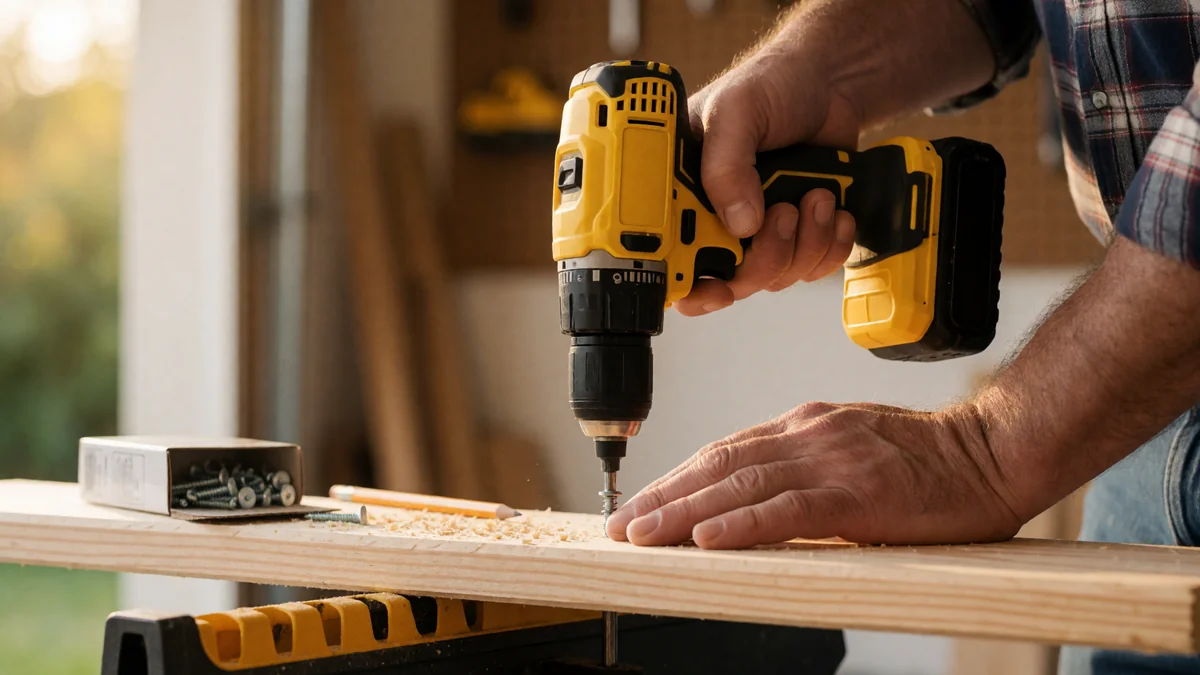
A cordless drill/driver is the tool most homeowners use more than any other: hanging shelves, assembling furniture, swapping cabinet hardware, building a raised bed. The best cordless drill for homeowners isn’t the most powerful one on the shelf. It’s the one that’s comfortable, reliable, and part of a battery system you’ll keep adding to. We compared popular kits using manufacturer specs, independent reviews, and long-term owner feedback.
Quick answer: For most homeowners, the DEWALT 20V MAX DCD777D1 is the best cordless drill: compact, brushless, two-speed, and sold as a kit with a 2.0Ah battery and charger. If you want a bit more torque and a premium feel, the Makita XFD131 is excellent. For light-duty jobs on a budget, the BLACK+DECKER LDX120C is a solid starter drill.
Get our best DIY tips, free
Practical home and yard projects, tool picks, and money-saving fixes in your inbox. No spam, unsubscribe anytime.
Drill vs. impact driver: which do you need?
A drill/driver does both jobs most homeowners need: drilling holes and driving screws, with an adjustable clutch so you don’t strip screws or sink them too deep. An impact driver is better for driving lots of long screws, like building a deck, but it’s not great for drilling precise holes. If you’re buying one tool, buy a drill/driver. Add an impact driver later if you start bigger projects.
What to look for in a cordless drill
Voltage: 12V vs. 18V/20V
12V drills are smaller and lighter, great for furniture assembly and light jobs. 18V and 20V MAX drills (these are the same class; brands just label them differently, and DeWalt notes its 20V MAX batteries are 18V nominal) have more power for drilling into studs, hardwood, or masonry with the right bit. For an all-around homeowner drill, 18V/20V is the safer bet.
Brushless motor
Brushless motors run cooler, last longer, and get more work out of each battery charge. They cost a bit more, but for a tool you’ll own for a decade, it’s worth it.
Chuck size and speed settings
A 1/2-inch chuck accepts bigger bits than a 3/8-inch chuck. Two speed settings, a low gear for driving screws and a high gear for drilling, make a drill far more versatile.
Battery platform
This is the big one. Once you own a brand’s batteries, you’ll want its other tools, from leaf blowers to string trimmers. Pick a brand with a lineup you like.
Best cordless drill for homeowners: our picks
Best overall
DEWALT 20V MAX Compact Brushless Drill/Driver Kit (DCD777D1)
A long-running favorite for homeowners: compact enough for tight cabinets, powerful enough for everyday drilling into studs, and it slots into DeWalt’s huge 20V MAX lineup. The kit includes a 2.0Ah battery and a charger, and you can add a second 20V MAX battery later if you want one charging while you work.
- Brushless motor in a compact body
- Two-speed transmission and 1/2-inch ratcheting chuck
- Kit includes a 2.0Ah battery and charger
As an Amazon Associate we earn from qualifying purchases, at no extra cost to you.
Premium pick
Makita XFD131 18V LXT Brushless Driver-Drill Kit
Makita’s popular brushless 18V drill/driver has a little more muscle and a reputation for smooth, well-balanced handling. A strong choice if you’re starting fresh and like Makita’s yard tools.
- Up to 440 in-lbs of max torque, per Makita
- Two speeds: 0–500 and 0–1,900 RPM
- 1/2-inch chuck and built-in LED light
As an Amazon Associate we earn from qualifying purchases, at no extra cost to you.
Budget pick
BLACK+DECKER 20V MAX Cordless Drill/Driver (LDX120C)
If you mostly assemble furniture, hang pictures, and tighten loose hinges, this affordable drill covers the basics. It’s not built for heavy daily use, but it’s a well-reviewed first drill for apartments and new homeowners.
- 11-position clutch helps prevent stripped screws
- 3/8-inch keyless chuck and LED work light
- Lightweight and easy to handle
As an Amazon Associate we earn from qualifying purchases, at no extra cost to you.
How we picked
We haven’t run our own lab tests on these drills. We narrowed the field by looking at manufacturer specs, independent reviews from tool publications, and the long-term patterns in thousands of owner reviews, like battery life complaints, chuck slippage, or failures after a year or two. We favored brands with broad battery platforms and solid warranties, because that’s what matters most over years of ownership.
Accessories worth adding
A drill is only as good as the bits in it. Whatever kit you choose, plan on picking up:
- A driver bit set with Phillips, square, Torx, and hex bits, plus a magnetic bit holder
- A twist drill bit set for wood and metal, from 1/16 inch up to 1/2 inch
- A few masonry bits for anchors in brick or concrete
- A spare battery if your kit only came with one
- Safety glasses that you’ll actually wear
If the drill is a gift, a magnetic wristband for holding screws makes a fun add-on.
How to use a cordless drill like a pro
Match the bit to the job
Use twist bits for wood and metal, masonry bits for brick and concrete, and the right driver bit for each screw head. A worn Phillips bit is the number one cause of stripped screws.
Set the clutch
Start on a low clutch number when driving screws, and turn it up until the screw sits flush. Use the drill setting (the drill-bit icon) for drilling holes.
Pro tip: Driving into drywall? A low clutch setting stops before the screw tears through the paper.
Pick the right speed
Use speed 1 for driving screws and speed 2 for drilling. Let the drill do the work; pushing hard just wears out bits.
Charge smart
Lithium-ion batteries don’t need to be fully drained before charging. Store them indoors, away from extreme heat and cold.
Safety first: Wear safety glasses when drilling, and before drilling into walls, check for hidden wiring and pipes with a stud finder that detects AC wiring. Never drill directly above or below outlets and switches.
Put your new drill to work on our door weatherstripping guide, or check the DIY gift guide for accessories to go with it. It is also the main tool you will need to install a smart thermostat or build a shed.
Frequently asked questions
An 18V or 20V MAX drill/driver is the best all-around choice for home use. A 12V drill is lighter and fine for furniture assembly and light jobs.
For most people, yes. Brushless motors are more efficient, run cooler, and typically last longer than brushed motors.
Usually nothing meaningful. 20V MAX is the battery’s maximum voltage with no load; 18V is its nominal voltage under load. They’re the same class of tool.
Buy a drill/driver first. It drills holes and drives screws. An impact driver is a great second tool for big screw-driving projects.
Lithium-ion tool batteries often last several years with normal use. Storing them indoors at moderate temperatures helps them last longer.
The bottom line
If you’re buying one drill for the house, the DeWalt DCD777D1 kit is the one we’d buy. The Makita XFD131 is a great step up, and the Black+Decker LDX120C covers light jobs on a tight budget. Whichever you choose, spend a few minutes with the manual, practice on scrap wood, and remember you’re buying into a battery system, so pick the brand you’d be happy to build around.
Looking for a first project? A simple shelf, planter box, or birdhouse is a great way to get comfortable with a new drill. If you want ready-made plans with cut lists, TedsWoodworking is a downloadable plans library the seller says covers over 16,000 projects. (Affiliate link: I may earn a commission at no extra cost to you.)

Leave a Reply