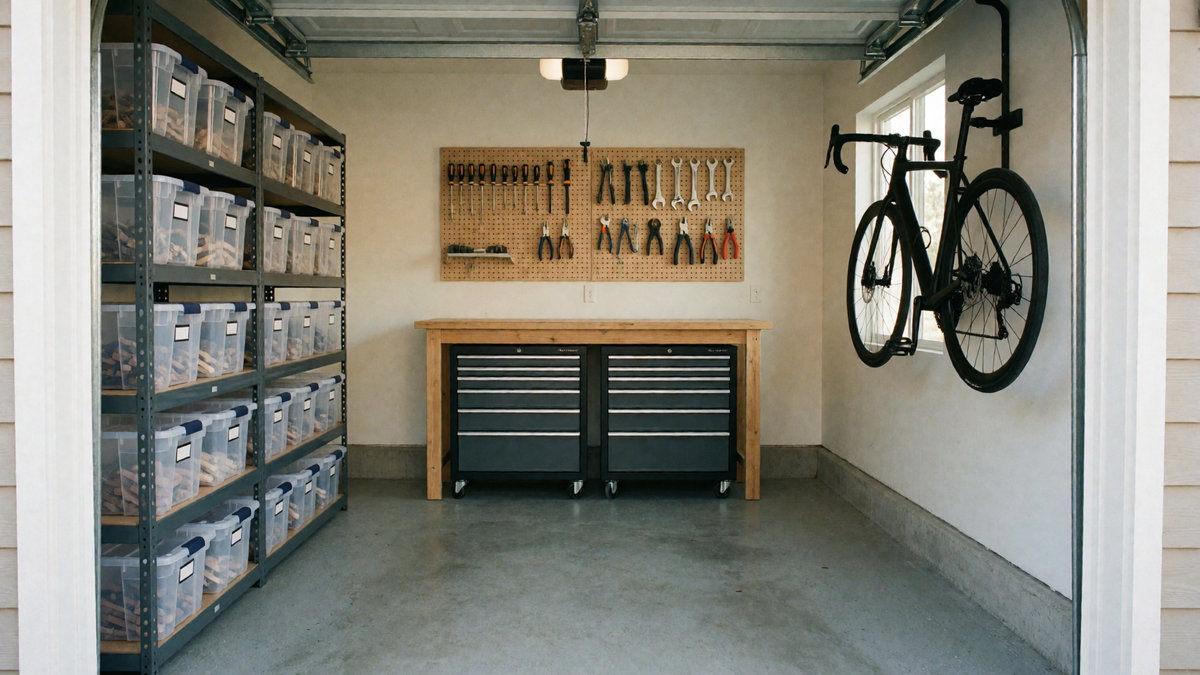
If you have to turn sideways to squeeze past the car, or you bought a second tape measure because the first one vanished, it’s time for a plan. This guide walks through how to organize a garage one step at a time: clear it out, sort what’s worth keeping, divide the space into zones, and then get everything up off the floor with shelving, wall storage, and overhead racks. Most two-car garages take one full weekend, or a few evenings if you tackle one zone at a time.
Quick answer: Empty it, sort it into keep, donate, sell, and trash piles, then plan zones before you buy anything. Put heavy, bulky things on sturdy floor shelving like the GARVEE 3-tier storage rack, hang long-handled tools and cords on a wall rail like the Rubbermaid FastTrack 15-piece kit, and move seasonal bins overhead onto a ceiling rack like the GARVEE 4×8 ft overhead rack. Label everything with a Brother P-touch PTD210 so it goes back where it belongs.
Get our best DIY tips, free
Practical home and yard projects, tool picks, and money-saving fixes in your inbox. No spam, unsubscribe anytime.
This is the first post in our Garage Organization series. Coming up next are deeper guides on garage shelving, wall storage systems, overhead racks, storing yard tools and bikes, workbench ideas, and garage organization on a budget. We’ll link each one here as it goes live.
Tools you’ll need
Tools
- Franklin Sensors ProSensor M210 stud finder
- Cordless drill/driver and bits
- 4 ft level and tape measure
- Step ladder
- Brother P-touch PTD210 label maker
- Push broom, shop vacuum, and work gloves
Materials
- Sterilite ClearView Latch 66 Qt bins
- IRIS USA WeatherPro 63 Qt gasket bins
- Rubbermaid FastTrack wall rail kit
- Contractor trash bags and boxes for donations
- Painter’s tape and a marker for the sorting zones
- Lag screws or anchors specified by your shelf and rack instructions
Time: one weekend for a two-car garage · Skill: Beginner to intermediate (overhead racks need two people) · Cost: low to moderate
How to organize a garage in 8 steps
1. Set a goal and pick your weekend
Decide what the garage needs to do for you. Park two cars? Hold a workbench? Store the lawn mower and the holiday decorations? Write the top three jobs on a piece of tape on the door to the house. That list decides what stays and where it goes.
Check the forecast and pick a dry weekend, because the next step puts everything on the driveway. Line up a donation drop-off or a bulk-trash pickup in advance so the discard pile actually leaves.
Pro tip: Start Saturday morning. If you run out of steam, a half-sorted driveway is much easier to deal with in daylight.
2. Empty the garage (or one zone at a time)
Pull everything out onto the driveway or lawn. It sounds extreme, but it’s the only way to see what you have, and it gives you an empty room to clean and measure. If a full clear-out isn’t practical, work one wall at a time and finish each section before you start the next.
Use painter’s tape on the driveway to mark four areas: keep, donate, sell, and trash. A fifth spot for “belongs in the house” catches the stray items that drift into the garage.
3. Sort ruthlessly
Handle each item once and put it in a pile. Be honest about duplicates, broken tools, dried-up paint, and hobbies you’ve moved on from. If you haven’t used something in two years and it isn’t seasonal or sentimental, it probably doesn’t need prime garage space.
Hazardous leftovers like old paint, solvents, pesticides, and motor oil shouldn’t go in the trash. Most cities and counties run household hazardous waste drop-offs, and many auto parts stores take used motor oil.
Pro tip: Group the keep pile by type as you go: lawn and garden, tools, sports, car care, holiday, and household overflow. Those groups become your zones.
4. Clean and inspect the empty space
With the floor empty, sweep and vacuum, wipe down the walls, and clean up oil spots. Look for problems you couldn’t see before: water coming in under the door or along the walls, signs of mice, or cracks in the slab. Fix leaks and pests before you put anything back.
This is also the time to find your wall studs and ceiling joists. A stud finder like the Franklin Sensors ProSensor M210 shows the whole stud width at once, which makes it easier to mark mounting points for rails, shelves, and overhead racks.
5. Map out zones
Sketch the garage on paper, with the car (or cars), the door to the house, the overhead door track, and any outlets. Then assign zones based on how often you use things:
Near the house door: everyday items like shoes, reusable bags, the recycling bin, and car-care basics. Along the side walls: lawn and garden tools, sports gear, and bulk household supplies. Back wall: the workbench and tool storage. Overhead: seasonal bins and things you use once or twice a year. Keep a clear path from the car doors to the house.
Pro tip: Measure the space between the car and the wall with the doors open. Most shelves need to be 24 inches deep or less to leave room to get out of the car.
6. Go vertical: shelves, walls, and the ceiling
Floor space is the most valuable real estate in the garage, so get as much as you can up and off the concrete. Here’s how the three main options split up the work:
Freestanding shelving holds bins, paint, and heavy supplies. A waist-high unit like the GARVEE 3-tier storage rack doubles as a counter, while taller units make the most of a long wall. For more sizes, browse Shelving.com’s boltless shelving. Anchor tall units to the wall so they can’t tip.
Wall rails and pegboard handle rakes, shovels, cords, ladders, and hand tools. A rail system like the Rubbermaid FastTrack 15-piece kit lets you move hooks around as your gear changes, and add-on Rubbermaid FastTrack utility hooks cover bulky items. Over the workbench, a metal pegboard like the Wall Control 4 ft pegboard kit keeps hand tools in sight. Coil extension cords and hoses with Wrap-It Storage Heavy-Duty straps and hang them from a hook.
Overhead racks are the best home for seasonal bins. A ceiling platform like the GARVEE 4×8 ft overhead rack bolts into the joists above the hood of a parked car. Follow the maker’s instructions for joist spacing and weight limits, keep it clear of the door track and opener, and plan for two people on ladders during installation.
7. Containerize and label everything
Clear bins let you see what’s inside without opening every lid. Stackable latching totes like the Sterilite ClearView Latch 66 Qt bins work well on shelves, and gasket-sealed bins like the IRIS USA WeatherPro 63 Qt bins help keep dust, moisture, and pests away from holiday decorations, camping gear, and clothing.
Label the short end of each bin so you can read it on the shelf. A label maker like the Brother P-touch PTD210 prints tape that holds up better in a cold, dusty garage than marker on masking tape. Keep loose hand tools, fasteners, and drill bits in a drawer unit like the GARVEE 5-drawer rolling tool cabinet instead of in open coffee cans on the bench.
Pro tip: Buy bins after you sort, not before. Count how many you need for each zone and stick to one or two sizes so they stack neatly.
8. Put it back by zone and keep it that way
Load the heaviest things on the lowest shelves and the things you use every week between knee and shoulder height. Light, rarely used items go up high or overhead. Store gas cans in approved containers away from the water heater, furnace, and any other flame or spark source, and keep pool chemicals, pesticides, and sharp tools up high or locked away from kids and pets.
Then build a habit: a 10-minute reset every weekend and a bigger seasonal swap twice a year. In spring, move the snow shovels overhead and bring the yard tools down. In fall, do the reverse, and it’s a good time to winterize your lawn mower before it goes into its spot for the season.
Safety first: Anchor tall shelving to wall studs, never exceed a shelf’s or rack’s rated load, and install overhead racks only into solid ceiling joists. If you aren’t sure what’s above your garage ceiling, have a pro look before you hang weight from it.
Our picks at a glance
- Easy first shelf: GARVEE 3-Tier Garage Storage Rack (48 x 18 x 36 in.)
- Best for seasonal bins: GARVEE 4×8 ft Overhead Garage Storage Rack
- Best for hand tools: GARVEE 5-Drawer Rolling Tool Cabinet
- Best wall rail starter kit: Rubbermaid FastTrack 15-Piece Garage Wall Storage Kit
- Best pegboard: Wall Control 4 ft. Metal Pegboard Tool Storage Kit
- Best clear bins: Sterilite ClearView Latch 66 Qt Storage Boxes (6-pack)
- Best sealed bins: IRIS USA WeatherPro 63 Qt Storage Bins (4-pack)
- Best label maker: Brother P-touch PTD210 Label Maker
Our picks for an organized garage
We don’t list prices because they change often. Every pick below links to the current listing, so check current price before you buy, and confirm the dimensions against your own measurements.
Shelving, overhead, and tool storage
Easy first shelf
GARVEE 3-Tier Garage Storage Rack (48 x 18 x 36 in., Matte Black)
A waist-high, boltless steel rack that snaps together with the included mallet. At 36 inches tall it fits under a window or beside a workbench, and the three adjustable shelves are rated for 1,500 lb total.
- Tool-free snap-together assembly
- Adjustable shelf heights
- Short enough to double as a work-height counter
’Round The House DIY may earn a commission if you buy through these links, at no extra cost to you.
Best for seasonal bins
GARVEE 4×8 ft Overhead Garage Storage Rack (660 lb, 22–40 in. drop)
A full 4×8 ft ceiling platform for totes and seasonal gear, with a drop adjustable from 22 to 40 inches and a 660 lb rating. Mount it into the ceiling joists above the hood of a parked car, clear of the door track.
- Large 4×8 ft deck
- Adjustable 22–40 in. height
- Grid deck keeps totes from sliding
’Round The House DIY may earn a commission if you buy through these links, at no extra cost to you. As an Amazon Associate we earn from qualifying purchases.
Best for hand tools
GARVEE 5-Drawer Rolling Tool Cabinet
A powder-coated steel cabinet with ball-bearing drawers, a lock, and swivel casters with brakes. It gives hand tools, fasteners, and small power-tool accessories one rolling home instead of a pile on the bench.
- Locking drawers
- Casters with parking brakes
- Ball-bearing drawer slides
’Round The House DIY may earn a commission if you buy through these links, at no extra cost to you.
If you want a taller open rack for bins, or a lockable cabinet for tools you would rather keep out of sight, VEVOR 5-tier 60 x 24 x 77 in. garage shelving and the VEVOR 70.87-inch metal storage cabinet (CB02) are solid next options alongside the GARVEE units above. Measure the space beside a parked car with the doors open, and check current price before you buy.

Best tall open rack
VEVOR 5-Tier 3000 lb Garage Shelving (60 x 24 x 77 in.)
The VEVOR 5-tier 60 x 24 x 77 in. garage shelving is a boltless, five-tier wire rack at 60 x 24 x 77 inches, with a 3,000 lb total rating (600 lb per shelf). That is a long, deeper wall unit for totes, paint, and bulky supplies, and it is taller than the waist-high GARVEE 3-tier rack above. Anchor it to the wall, and confirm the 24-inch depth still leaves room to open the car door.
- 60 x 24 x 77 in. five-tier wire rack
- 3,000 lb total rating, 600 lb per shelf
- Boltless steel frame with adjustable shelves
’Round The House DIY may earn a commission if you buy through these links, at no extra cost to you.

Best lockable cabinet
VEVOR Metal Storage Cabinet, 70.87 in., 4 Doors and 2 Drawers (CB02)
The VEVOR 70.87-inch metal storage cabinet (CB02) is a 70.87-inch steel cabinet with four locking doors, two drawers, and adjustable shelves rated for 180 lb each. It is a good home for chemicals, sharp tools, and anything you do not want sitting out on an open rack. The Amazon listing for this model can show style options; choose the immovable four-door, two-drawer cabinet to match this one.
- Four locking doors and two drawers
- Adjustable shelves, 180 lb per shelf
- Hidden leveling feet for uneven garage floors
’Round The House DIY may earn a commission if you buy through these links, at no extra cost to you. As an Amazon Associate we earn from qualifying purchases.
Wall storage and bins
Once the floor is zoned, the walls are where rakes, bikes, and hand tools stop eating parking space. The VEVOR 8 x 4 ft PVC slatwall (YLP-SS-8B-1) covers a full wall section with 3-inch slots that take standard slatwall hooks, baskets, and shelves. It is a modular alternative to a rail kit or a small pegboard, and you can add panels later. Screw into studs, and check current price before you order.

Best slatwall starter wall
VEVOR PVC Slatwall, 8 x 4 ft, Black (YLP-SS-8B-1)
The VEVOR 8 x 4 ft PVC slatwall (YLP-SS-8B-1) is an eight-panel PVC set that makes a 8 x 4 ft wall (32 square feet). Each panel is rated at 300 lb, with a standard 3-inch slot width that works with common slatwall hooks and shelves. PVC holds up better than hardboard in a damp garage, and you can cut panels to fit around outlets or a side door. Hang it on studs, and do not overload a single hook.
- 8 x 4 ft coverage (eight PVC panels)
- 300 lb rating per panel, 3-inch slot spacing
- Cuttable, modular panels you can expand later
’Round The House DIY may earn a commission if you buy through these links, at no extra cost to you.
Best wall rail starter kit
Rubbermaid FastTrack 15-Piece Garage Wall Storage Kit
The Rubbermaid FastTrack 15-piece kit comes with four rails and 11 hooks, which is enough to get rakes, shovels, a ladder, a hose, and cords onto one wall. The rails screw into studs, and the hooks click on and slide anywhere along them, so you can rearrange as your gear changes. Rubbermaid also sells FastTrack utility hooks, baskets, and shelves that fit the same rails.
- Four rails and 11 hooks in one box
- Hooks slide and reposition without tools
- Expandable with other FastTrack accessories
As an Amazon Associate we earn from qualifying purchases, at no extra cost to you.
Best pegboard
Wall Control 4 ft. Metal Pegboard Tool Storage Kit
Hardboard pegboard sags and the hooks fall out. The Wall Control 4 ft pegboard kit uses powder-coated steel panels with both round pegboard holes and Wall Control’s slots, so standard pegboard hooks and Wall Control’s locking hooks both fit. It’s a good match for the wall above a workbench.
- Steel panels that won’t sag or swell
- Accepts standard pegboard hooks
- Kit includes hooks and accessories
As an Amazon Associate we earn from qualifying purchases, at no extra cost to you.
Best clear bins
Sterilite ClearView Latch 66 Qt Storage Boxes (6-pack)
The Sterilite ClearView Latch 66 Qt bins are a big, stackable size for sports gear, kids’ outgrown clothes, and holiday decorations. The clear sides make the contents easy to spot, and the latching lid helps keep them closed when they’re stacked. Buying a six-pack keeps every bin on a shelf the same size.
- Clear sides for quick identification
- Latching lids; stack when full
- Six matching bins per pack
As an Amazon Associate we earn from qualifying purchases, at no extra cost to you.
Best sealed bins
IRIS USA WeatherPro 63 Qt Storage Bins (4-pack)
Garages get dusty, damp, and occasionally visited by mice. The IRIS USA WeatherPro 63 Qt bins have a gasket seal and buckle latches, according to IRIS, which makes them a better pick for anything you’d hate to find dusty or chewed: holiday linens, sleeping bags, and paperwork.
- Gasket-sealed lid with buckle latches
- Clear plastic body
- Good size for overhead racks
As an Amazon Associate we earn from qualifying purchases, at no extra cost to you.
Best label maker
Brother P-touch PTD210 Label Maker
Labels are what keep an organized garage organized. The Brother P-touch PTD210 is a simple handheld label maker with a full keyboard, and this bundle includes extra label tapes. Print labels for bin ends, shelf edges, and the breaker panel while you’re at it.
- Easy keyboard layout
- Bundle includes extra label tapes
- Labels for bins, shelves, and cords
As an Amazon Associate we earn from qualifying purchases, at no extra cost to you.
Common garage organization mistakes
- Buying storage before sorting. You’ll end up with bins for things you’re about to donate. Sort first, measure second, buy third.
- Shelves that are too deep. Deep shelves eat parking space and bury things in the back. 18 to 24 inches is plenty for standard bins.
- Ignoring the walls and ceiling. Most garages have far more unused wall and ceiling space than floor space. Rails, pegboard, and an overhead rack free up the floor.
- Storing the wrong things in the garage. Heat, cold, and humidity are hard on paint, electronics, photos, and lithium-ion batteries. Keep lithium-ion tool batteries indoors at room temperature in winter, whether they run a drill or one of our favorite cordless leaf blowers.
- No home for new stuff. Leave about 20% of each zone empty so the next purchase has somewhere to go.
When the garage still isn’t big enough
If you’ve sorted, purged, and gone vertical and it’s still packed, the lawn and garden gear may need its own building. Our guide on how to build a shed walks through it step by step. And if the cordless tools are scattered across three battery brands, our guide to the best cordless drill for homeowners can help you settle on one platform, which means one charging station on the wall instead of three. Once the workbench is clear, a jobsite speaker makes weekend projects a lot more fun.
How we put this guide together
We didn’t put these products through hands-on testing. This plan is based on standard garage organization practice and manufacturers’ installation guidance. We chose the products by comparing manufacturer specs (dimensions, load ratings, and mounting requirements) and summarizing what owners say in reviews. We checked that every product was listed and in stock on Nov 20, 2026.
Deals for this project
Once the floor is clear, sturdy shelving keeps bins, seasonal gear, and paint off the concrete. Start with Shelving.com’s garage storage collection, or browse GARVEE’s garage storage racks for heavy-duty floor units.
’Round The House DIY may earn a commission if you buy through these links, at no extra cost to you.
Frequently asked questions
Empty it, or at least one section of it, and sort everything into keep, donate, sell, and trash piles. You can’t plan storage until you know what you’re keeping.
Most one- or two-car garages take a full weekend: one day to empty, sort, and clean, and one day to install storage and put things back. Very full garages can take two weekends.
Purge first, since getting rid of things is free. Then use wall hooks and one sturdy shelving unit before you spend money on cabinets or a full wall system. Reuse bins you already own and label them.
Avoid storing paint, propane cylinders, photos, important papers, electronics, and food in a garage that gets very hot or cold. Lithium-ion tool batteries do best indoors at room temperature. Store gasoline only in approved containers away from flames.
For most garages, 18 to 24 inches deep is enough for standard storage bins while leaving room to walk and open car doors. Measure your parking space before you buy.
Yes, when they are installed into solid ceiling joists, loaded within the rated capacity, and kept clear of the garage door and opener. Follow the manufacturer’s instructions and use two people to install them.
The bottom line
Knowing how to organize a garage comes down to an order of operations: empty it, sort it, clean it, zone it, then go vertical. A floor rack like the GARVEE 3-tier storage rack handles the heavy stuff, a Rubbermaid FastTrack rail kit or Wall Control pegboard takes care of the walls, and a ceiling rack like the GARVEE 4×8 ft overhead rack frees up the floor for seasonal bins. Add matching Sterilite ClearView bins and a label maker, and give yourself ten minutes a week to put things back.

Leave a Reply